
Cart 0

Published in:
Business
Why Color Sorter Machines Are Essential for Export-Quality Grains in 2025

Introduction
As India continues to grow as a leading exporter of rice, wheat, pulses, spices, and oilseeds, the demand for high-quality, defect-free, and visually perfect grains has increased significantly. International markets such as the Middle East, Europe, North America, and Africa follow strict quality and visual standards before approving grain imports.
In export consignments, even a small percentage of defective grains can result in:
- Shipment rejection
- Heavy financial losses
- Brand reputation damage
- Return freight and penalties
- Loss of future export contracts
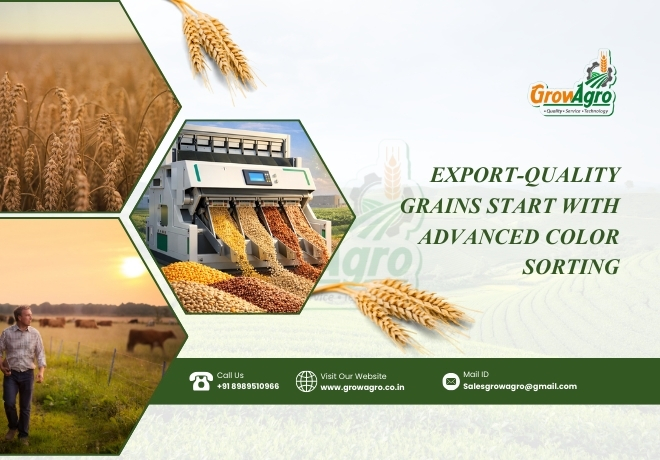
To meet these stringent requirements, modern agribusinesses, rice mills, pulse processors, food companies, and seed plants rely on Color Sorter Machines. These advanced optical sorting systems detect and remove defective grains based on color, size, shape, and surface imperfections.
This blog explains how color sorter machines work, why they are essential for export-grade grain processing, and how Grow Agro Hi-Tech Solutions delivers reliable and high-performance sorting technology.
What Is a Color Sorter Machine?
A Color Sorter Machine is an advanced optical sorting system designed to identify and eliminate visually defective grains using cutting-edge technology, including:
- Ultra high-resolution cameras
- RGB or CCD vision sensors
- LED and infrared lighting
- AI-based algorithms
- High-speed ejector valves
Color sorters are widely used in modern grain processing industries where visual quality directly affects market value and export acceptance.
How a Color Sorter Machine Works: Step-by-Step
Step 1: Feeding
Grains are evenly fed through a vibrating feeder and guided onto sorting chutes to maintain a uniform flow.
Step 2: Optical Camera Inspection
High-resolution cameras scan each grain at extremely high speed, analyzing:
- Color
- Shape
- Surface texture
- Size
- Spots and discoloration
- Mold or fungal marks
- Foreign particles
Step 3: AI-Based Decision Making
Advanced software compares every grain against pre-set quality parameters. Even minute defects, as small as a fraction of a millimeter, are detected and marked for rejection.
Step 4: High-Speed Ejection
Precision air-jet ejectors instantly remove defective grains from the product stream, while acceptable grains continue uninterrupted.
Step 5: Final Output
The result is a batch of grains that is:
- Pure
- Uniform
- Visually clean
- Perfectly sorted
- Export-ready
Defects Removed by Color Sorter Machines
Color sorters eliminate impurities and defects that traditional cleaners, graders, or gravity separators cannot detect, including:
- Discolored grains
- Dark or black spots
- Mold and fungal contamination
- Insect-damaged seeds
- Chalky rice kernels
- Black-tipped grains
- Broken grain pieces
- Glass or plastic contaminants
- Burnt or heat-damaged grains
- Shriveled or immature seeds
- Foreign materials similar in size to grains
This ensures the final product meets the highest global quality standards.
Why Visual Quality Is Critical for Export Grains
International buyers place strong emphasis on grain appearance. Visual quality directly influences:
- Market price
- Buyer acceptance
- Consumer trust
- Brand reputation
Even nutritionally sound grains can lose 20 to 40 percent of their value due to visual defects. Export markets demand:
- Uniform color
- Clean and polished appearance
- No black or white spots
- No mold or discoloration
- Zero foreign matter
Color sorter machines deliver this level of precision consistently.
Grains and Crops That Require Color Sorting
Rice
- Basmati rice
- Sona Masuri
- Parboiled rice
- Raw rice
Color sorting removes chalky grains, black tips, discolored kernels, and remaining paddy grains.
Wheat
Removes black grains, damaged kernels, fungal spots, and foreign seeds.
Pulses
- Chana
- Moong
- Masoor
- Urad
- Toor
Eliminates insect-damaged seeds and off-color grains.
Spices
- Coriander
- Cumin
- Mustard
- Fenugreek
- Sesame
Removes foreign particles and discolored seeds.
Seeds
Hybrid and certified seeds require perfect visual quality for acceptance.
Coffee Beans
Removes defective beans and foreign material.
Oilseeds
Ensures clean and uniform sesame, mustard, and sunflower seeds.
Advantages of Using Color Sorter Machines in 2025
Higher Market Value
Visually clean and uniform grains command premium prices in both domestic and export markets. Sorted rice, for example, often sells at 15 to 25 percent higher value.
Elimination of Human Error
Manual sorting is slow, inconsistent, labor-intensive, and costly. Color sorters provide fully automated and error-free sorting.
Higher Processing Efficiency
Color sorters operate at extremely high speeds, sorting thousands of grains per second and significantly increasing plant output.
Reduced Product Waste
Accurate defect detection ensures only defective grains are rejected, minimizing product loss.
Compliance With Export Standards
Color sorter machines help products pass food safety inspections, visual quality checks, and export grading requirements of countries such as the UAE, Saudi Arabia, the UK, the USA, Europe, and Africa.
Stronger Brand Reputation
Consistent visual quality helps businesses build trust and establish a premium brand image in global markets.
Protection of Downstream Machinery
Foreign materials like glass, plastic, or stones are removed before milling or packaging, preventing equipment damage.
Why Grow Agro Color Sorter Machines Stand Out
Grow Agro Hi-Tech Solutions offers advanced, AI-powered color sorter machines trusted by grain processors, seed companies, and exporters across India.
Key Features
- AI-driven defect detection
- CCD, RGB, and NIR optical technology
- High-speed ejector valves
- Stainless steel product contact parts
- Automatic lens cleaning system
- User-friendly touchscreen controls
- Low reject ratio
- Multi-crop compatibility
- High processing capacity
With over 20 years of engineering expertise and 14,000 satisfied customers, Grow Agro machines are built for continuous industrial operation.
Cost of Color Sorter Machines
The cost of color sorter machines depends on several factors:
- Number of sorting channels
- Camera and sensor technology
- Ejector valve quality
- Processing capacity
- Level of automation
Typical investment ranges:
- Small units (32 to 48 channels): 8 to 15 lakh INR
- Medium units (64 to 96 channels): 15 to 30 lakh INR
- Large industrial units (128 or more channels): 30 to 60 lakh INR
The investment is quickly recovered through higher selling prices and reduced shipment rejections.
Conclusion
Color Sorter Machines are no longer optional; they are essential for any grain, pulse, seed, or spice processing business aiming to compete in domestic and global markets. With advanced optical inspection, AI-based sorting, and high-speed defect removal, color sorters ensure only the cleanest, purest, and most visually perfect grains reach buyers.
By installing a Color Sorter Machine from Grow Agro Hi-Tech Solutions, businesses achieve higher selling prices, stronger brand reputation, export-ready quality, zero human error, and maximum profitability. Whether processing rice, wheat, pulses, spices, or oilseeds, color sorting is the key to premium quality in 2025 and beyond.