
Cart 0

Published in:
Business
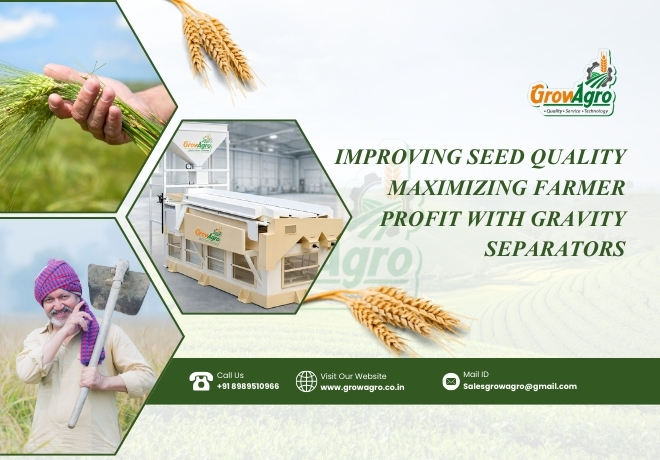
How Gravity Separators Improve Seed Quality and Increase Farmer Profit in 2025

Introduction
In modern agriculture, where farmers and seed companies aim for higher productivity, stronger yields, and better profitability, the Gravity Separator has become an indispensable machine. Whether processing wheat, pulses, maize, mustard, sesame, groundnut, or hybrid vegetable seeds, the final quality of the seed lot directly determines market success.
Seeds may look identical externally, yet differ greatly in internal quality. This is why gravity-based separation plays a crucial role in modern seed processing. Unlike size or visual sorting, gravity separation works on seed density, the most reliable indicator of seed health, maturity, and growth potential.
This guide explains what gravity separators are, how they work, why they matter, and how they significantly increase farmer and seed company profitability.
What Is a Gravity Separator?
A Gravity Separator is an advanced seed processing machine that separates seeds based on density (specific gravity) rather than size, shape, or color.
Even seeds of the same size can differ internally:
- Fully matured seeds
- Half-filled seeds
- Empty or lightweight seeds
- Insect-damaged seeds
- Diseased seeds
These differences are not visible to the naked eye. Gravity separators identify and separate such seeds automatically.
The separation process uses a combination of:
- Controlled airflow
- Deck vibration
- Deck inclination
- Density differences
- Stratification
Only heavy, healthy seeds move forward, while light, weak, and defective seeds are removed.
Why Seed Density Matters More Than Size or Color
Many seed processors rely only on sieves, color sorting, or manual inspection. However, industry experience and research confirm that seed density is the most accurate indicator of quality.
This is because:
- Healthy seeds are heavier
- Immature seeds are lighter
- Insect-damaged seeds lose internal mass
- Shriveled seeds have low density
- Poorly filled seeds weigh less
Two seeds may look identical externally, but only gravity separation can detect internal biological strength.
How a Gravity Separator Works: Step-by-Step
Step 1: Feeding
Raw seeds are fed through a hopper and evenly distributed across the gravity deck.
Step 2: Stratification
Air flows upward through the vibrating deck. Lighter seeds rise while heavier seeds settle lower.
Step 3: Layer Formation
The material forms multiple layers based on density:
- Heavy seeds (highest density)
- Medium-density seeds
- Light seeds
- Rejects and dust (lowest density)
Step 4: Deck Vibration
Vibration and deck angle move the material:
- Heavy seeds move upward and forward
- Light seeds move downward and backward
Step 5: Controlled Discharge
Separate outlets collect:
- Premium-grade seeds
- Standard-quality seeds
- Rejected material
Operators can adjust airflow, vibration, and deck inclination to achieve precise separation.
Defects and Impurities Removed by Gravity Separators
Gravity separators remove quality defects that cannot be eliminated by normal graders or sieves, including:
- Immature seeds
- Shriveled seeds
- Empty or partially filled grains
- Insect-damaged seeds
- Mold-affected seeds
- Lightweight broken seeds
- Thin and weak grains
- Low-mass foreign particles
Only high-density, fully mature seeds proceed for packaging or further processing.
Crops That Benefit Most from Gravity Separation
Cereals
- Wheat
- Paddy
- Maize
- Sorghum
- Bajra
Pulses
- Chana
- Moong
- Masoor
- Urad
- Arhar (Toor)
Oilseeds
- Sesame
- Sunflower
- Mustard
- Groundnut
Hybrid and Vegetable Seeds
- Tomato
- Chili
- Cucumber
- Onion
- Okra
Spices
- Coriander
- Cumin
- Fenugreek
All crop categories show significant quality improvement after gravity separation.
Benefits of Gravity Separators for Farmers and Seed Companies
Higher Germination Rates
Only fully matured, nutrient-rich seeds pass gravity separation, resulting in better germination, stronger root development, and higher yield.
Better Market Value
High-density and uniform seed lots command premium prices in domestic and export markets.
Removal of Insect-Damaged Seeds
Internal insect damage is removed even when the outer shell appears normal, preventing poor crop performance.
Essential for Hybrid Seed Production
Hybrid seeds require high purity, strong vigor, and uniform density. Gravity separators are mandatory for hybrid seed units.
Compliance With Government and Export Standards
Certified seed programs, government tenders, and export consignments require strict density and purity standards, which gravity separators help achieve.
Increased Farmer Profitability
Farmers using high-quality, dense seeds experience better crop establishment, higher yields, and reduced re-sowing costs.
Reduced Post-Harvest Losses
Low-quality seeds are removed early, minimizing losses for both farmers and processors.
Gravity Separators vs. Simple Seed Graders
Seed graders separate material by size, but size alone does not guarantee quality. Large seeds can still be immature, empty, weak, or infected, while smaller dense seeds can be healthy.
Gravity separation focuses on quality-based selection, while grading focuses on size-based separation. For premium and export-quality seed processing, gravity separators are essential.
Why Grow Agro Gravity Separators Stand Out
Grow Agro Hi-Tech Solutions offers reliable gravity separators engineered for:
- High precision separation
- Low maintenance
- Long deck life
- High throughput
- Continuous industrial operation
Key Features
- Heavy-duty MS construction
- Wooden decks for gentle seed handling
- Adjustable airflow and deck angle
- Multi-crop compatibility
- Accurate impurity removal
- Dust canopy options
- Industrial-grade motors and blowers
Trusted by over 14,000 customers across India.
Applications in Modern Seed Processing Plants
Gravity separators are typically installed:
- After the seed grader
- Before destoners or color sorters
- In certified seed units
- In hybrid seed plants
- In export-oriented processing lines
They significantly improve the efficiency and output quality of the entire plant.
Cost of Gravity Separator Machines
The cost of gravity separators depends on:
- Processing capacity (TPH)
- Deck size
- Airflow system
- Canopy and dust control options
- Customization requirements
Typical price ranges:
- Small units: 1.5 to 2.5 lakh INR
- Medium units: 2.5 to 4 lakh INR
- Large industrial units: 4 to 7 lakh INR
The return on investment is high due to improved seed quality and increased selling price.
Conclusion
Gravity separators are no longer optional; they are essential for profitable and quality-driven seed processing. By removing low-density, immature, and defective seeds, they ensure better germination, higher crop yields, improved market value, compliance with standards, and stronger brand reputation.
Whether you operate a small seed unit, a large agribusiness, or an export processing facility, installing a Gravity Separator from Grow Agro Hi-Tech Solutions is a smart and profitable investment.